
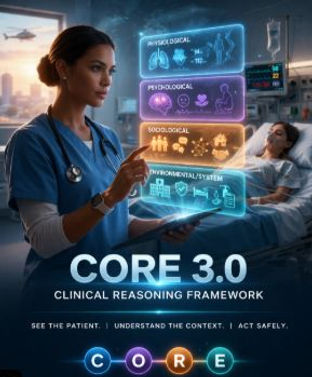
C.O.R.E. 3.0™
A Practical Framework for Nursing Clinical Reasoning
C.O.R.E. 3.0™ was developed to reflect how healthcare professionals actually think, prioritize, act, and adapt in complex clinical environments. Originally created as an evolution of the nursing process, its architecture also has broader relevance across multiple healthcare disciplines. In nursing, it evolves the logic of the nursing process into a more Contextual, Organized, Rational, and Evolutive framework for clinical nursing excellence.
Developed through the work of Cristina Privat and supported by the vision of the International Nursing Alliance (INA), C.O.R.E. 3.0™ offers a practical and globally adaptable structure for strengthening nursing judgment in real-world settings.
Why C.O.R.E. 3.0™ Was Developed
As healthcare evolves and patient care becomes more complex, students are expected to move from theory into simulation, laboratory practice, and clinical placement while still learning how to connect what they know into one coherent reasoning process.
In many nursing programs, learners are taught the foundations of nursing science, including the nursing process - assessment, diagnosis, planning, intervention, and evaluation -together with ethics, legal responsibilities, communication, prioritization, and professional standards. However, these elements are not always experienced as one interconnected clinical logic. This fragmentation can make the transition from theory to applied clinical environments stressful, cognitively demanding, and psychologically challenging.
C.O.R.E. 3.0™ was designed to help bridge that gap.
What C.O.R.E. 3.0™ Does
C.O.R.E. 3.0™ helps students:
• understand situations contextually
• organize cues and priorities
• justify safe nursing action
• reassess outcomes and adapt
• build confidence before applied learning
Its purpose is direct and practical: to operationalize clinical reasoning into a structured teaching and learning method that prepares students before higher-pressure environments such as simulation, laboratory learning, and clinical placement.
The Four Phases of C.O.R.E. 3.0™
Contextual
Helps learners understand the patient situation as a whole rather than through isolated data points.
Using the 4D Clinical Prism, students are guided to consider:
• physiological factors
• psychological factors
• sociological factors
• environmental factors
Organized
Helps learners transform collected information into meaningful patterns, priorities, and defensible clinical concerns.
This phase supports:
• cue clustering
• pattern recognition
• prioritization
• contextualized clinical judgment
Rational
Guides the choice of nursing actions that are:
• safe
• justified
• ethical
• legal
• professionally appropriate
Evolutive
Ensures that care does not stop at intervention. It continues through:
• reassessment
• documentation
• adaptation
• reflective learning
• continuous improvement
These phases are interconnected, not rigid. They are designed to guide real-time clinical judgment in fast-paced and changing care environments.
What Makes C.O.R.E. 3.0™ Different
C.O.R.E. 3.0™ does not reject traditional nursing foundations. It builds on them.
It is best understood as a pedagogical evolution of the nursing process and related clinical reasoning approaches. Its value lies in making reasoning more:
• visible
• teachable
• practical
• interconnected
• transferable across learning environments
C.O.R.E. 3.0™ was not designed as a purely abstract academic model. It was designed to remain practical and usable in demanding care environments.
C.O.R.E. 3.0™ makes clinical reasoning more visible, more teachable, and more transferable across the full learning pathway.
A Broader Educational Ecosystem
C.O.R.E. 3.0™ links its cognitive framework directly to:
• syllabi
• lectures
• online modules
• workbook activities
• quizzes
• the Clinical Mirror
• handbooks
• guided application activities
This creates a bridge between classroom theory, simulation, laboratory learning, and clinical placement.
AiNCaT™
AiNCaT™ (Advanced Interactive Navigating Competency Assessment Tool) is the applied simulation environment of the broader C.O.R.E. 3.0™ ecosystem.
It is designed as an interactive, competency-oriented platform in which learners apply the cognitive logic of C.O.R.E. 3.0™ in realistic clinical situations. Its educational value lies in making clinical reasoning:
• observable
• measurable
• remediable
In this way, C.O.R.E. 3.0™ provides the reasoning framework, while AiNCaT™ provides the applied environment in which that logic becomes visible in action.
Educational Value
C.O.R.E. 3.0™ helps:
• make clinical reasoning more observable
• support safer prioritization and decision-making
• strengthen theory-to-practice transfer
• support reflective and accountable practice
• improve readiness before simulation, laboratory practice, and clinical placement
• support confidence-building and psychological readiness before applied learning
Global Relevance
C.O.R.E. 3.0™ was designed with international relevance in mind. Although laws, institutional structures, and delegation models differ, the need for safe, ethical, accountable, and context-sensitive judgment remains universal.
It is especially relevant for:
• schools of nursing
• clinical educators
• bridge and transition programs
• internationally educated nurses
• simulation-based education
• global nursing competency initiatives
Important Notice
C.O.R.E. 3.0™ is an educational and professional framework. It does not replace jurisdiction-specific laws, regulatory standards, institutional policies, or scope-of-practice requirements.
Strengthening Nursing Reasoning Before Practice
C.O.R.E. 3.0™ was developed to help strengthen nursing education and clinical practice in a way that is modern, practical, teachable, and globally adaptable.
Its ultimate goal is to help students build confidence and develop the key competencies required for safe, ethical, legal, and professional nursing practice before entering simulation and real clinical settings.
We welcome feedback from qualified professionals in nursing education, clinical practice, and healthcare leadership.